 ZHEZKAZGAN
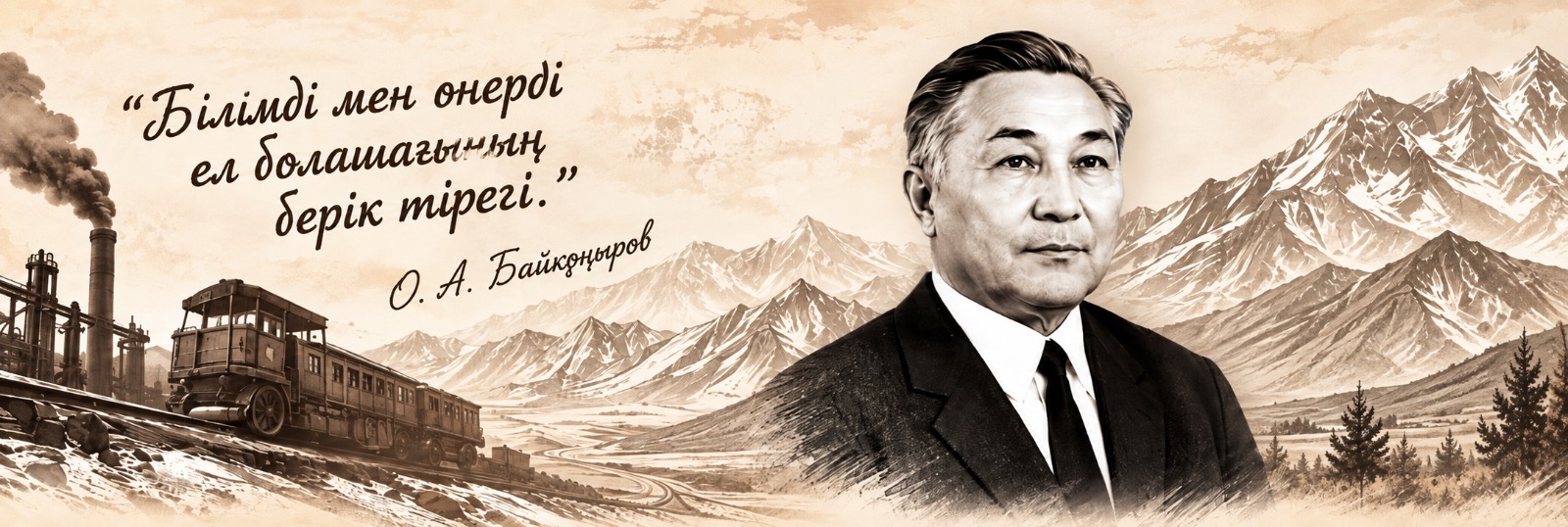
Omirkhan Aimaganbetovich Baikonurov
14.09.1912 — 15.03.1980
Omirkhan Aimaganbetovich Baikonurov was born on 14 September 1912 in Somke, Ulytau district. His early life and work were connected with Karsakpay, an important centre in the development of Kazakhstan’s non-ferrous metallurgy.
He began working on the construction of the Karsakpay copper smelter. In 1931–1932 he attended a factory training school, qualifying as a drilling foreman. Meeting Kanysh Satpayev shaped his interest in geology and mining.
Baikonurov combined industrial work with continuing education. On Satpayev’s recommendation he studied in Almaty and entered the Kazakh Mining and Metallurgical Institute. He graduated in 1940 as a mining engineer specialising in mineral deposit development.
After graduation he returned to Zhezkazgan. He worked as a shift foreman, mine manager and head of a mining administration. This practical experience informed both his research and his approach to educating engineers.
In 1952 he became director of the Kazakh Mining and Metallurgical Institute. Under his leadership the institute developed its engineering education and research. It was reorganised as a polytechnic institute in 1960.
In 1962 Baikonurov was elected an academician of the Academy of Sciences of the Kazakh SSR. From 1964 until the end of his life, he headed the department of deposit development technology and integrated mechanisation at the Kazakh Polytechnic Institute.
His research focused on improving underground and surface mining methods. He connected theoretical work with industrial challenges, paying particular attention to selecting effective methods of mineral extraction.
Baikonurov established a research school and supervised more than 60 candidates and 10 doctors of technical sciences. His legacy includes more than 300 scientific works and 30 inventions, recognised in Kazakhstan and abroad.
Zhezkazgan University, a mining institute and streets in several cities bear his name. The university preserves his legacy in science, education and the development of the region.
Family
Omirkhan Baikonurov and his wife Maria raised their son Karim and daughters Roza, Aliya and Alma. Their careers spanned engineering, medicine, science and education.
Life principles
His diaries reflect on responsibility to the next generation: sustaining a research school, passing experience to students and serving society through science.
A formula for success
Baikonurov valued perseverance, hard work and the ability to discover new ideas. These principles connected his industrial, scientific and educational work.